MES SaaS vs. On-premises MES: A 3-Year Total Cost of Ownership Comparison Manufacturers Can’t Ignore

Why Compare the Total Cost of Ownership (TCO) of an MES?


The Total Cost of Ownership (TCO) refers to all expenses related to a solution throughout its entire lifecycle, far beyond the initial purchase price. For an MES, this includes not only licenses or subscriptions, but also infrastructure, implementation, maintenance, updates, technical support, training, and the internal resources involved. Calculating and understanding the TCO is fundamental, as it enables an objective comparison between different deployment models—on-premises, private cloud, or SaaS—and provides a comprehensive, accurate, and realistic view of the medium- and long-term investment required. This approach prevents a focus solely on the entry price and reveals the real savings or additional costs of each option, forming the basis for an informed, sustainable strategic decision. 

When a manufacturer plans to implement an MES, the actual cost far exceeds just the software license. It includes integration with existing systems (ERP, SCADA, etc.), configuration, user training, server and equipment management, ongoing support, and even the risks associated with production downtime. Without a clear understanding of the TCO, it becomes difficult to anticipate the financial and operational impact of a solution, which can lead to poor cost estimates and, ultimately, to unsuitable technology choices. 

Comparing the Total Cost of Ownership (TCO) of different MES deployment methods provides a complete and realistic picture of the investments required—not just for implementation, but for maintaining the solution throughout its lifecycle. 

This article highlights the significant cost differences between deploying an MES SaaS and an on-premises MES, not only in financial terms but also regarding internal resources, flexibility, and operational resilience. By evaluating TCO, decision-makers can anticipate costs, better plan their budgets, and choose the MES deployment type best suited to their growth strategy and digital transformation. 

Methodological Note 

Each MES deployment is unique and designed to meet the specific needs of the organization. However, this article offers a realistic cost estimate for organizations considering MES implementation. It presents a rigorous 3-year total cost of ownership (TCO) comparison between an MES SaaS and a locally deployed MES. 

Several assumptions are drawn from research (LNS Research, ARC Advisory Group, Gartner) and our practical experience. All detailed assumptions are provided in the Appendix 1.

A Realistic MES Deployment Scenario for a Mid-Sized Manufacturing Company


Typical MES Installation Profile:

This study is based on a representative scenario of a mid-sized manufacturing company with about 150 MES-connected users or 100 pieces of production equipment integrated into the system. This profile reflects the reality on the ground: operators, supervisors, quality, maintenance, and management interacting with machines, PLCs, sensors, and other connected devices. 

The data aligns with deployments observed in the industry: mid-sized companies typically have 50 to 300 users and a hundred or more connected pieces of equipment, depending on their level of automation. 

Moreover, for a mid-sized company, 100 connected pieces of equipment represents a realistic level to ensure full coverage of the production process while remaining manageable for operational and IT teams.

Why Is This MES Deployment Scale Relevant?


It illustrates the situation of many mid-sized industrial companies undergoing digital transformation. These organizations have reached a maturity level where a robust MES becomes essential, yet they may not have the internal resources to manage a heavy infrastructure. 

Their strategic dilemma is clear: invest in an on-premises MES with its high costs and complexity, or opt for an MES SaaS model that is more agile, secure, reliable, and robust. 

Understanding MES SaaS Pricing Models


The Most Common Pricing Models in the Industry

MES SaaS providers adapt their pricing according to three main models, and it is crucial for companies to understand them in order to accurately assess the total cost of ownership (TCO) over several years.

1. Per userEach active user (operator, supervisor, administrator) incurs a monthly or annual fee. This model is ideal when the number of users is limited and stable, as it ensures predictable costs. 

2 . Per connected equipment Billing is based on the number of machines or devices integrated (production lines, PLCs, sensors). Each piece of equipment generates a cost related to data access and maintenance. This model is suitable when value lies mainly in equipment tracking, even if there are many users. 

3. Hybrid A mixed model that charges by both user and equipment, often adjusted based on actual usage. It balances flexibility and predictability, particularly for companies with both many operators and an extensive infrastructure. 

The Real Cost of an MES: It’s More Than Just Licenses


When evaluating an MES project, focusing only on license costs can be misleading. In reality, costs extend far beyond: servers and infrastructure, IT time and resources, initial deployment, ongoing maintenance, updates, and even the risks associated with production downtime. 

This is why we have modeled two complete scenarios—an MES SaaS deployment and an on-premises MES deployment—to compare the true 3-year total cost of ownership. 

It is important to note that the cost model presented in this article does not include the hidden costs often associated with on-premises MES. These can include, for example, increased maintenance complexity, unexpected downtime during upgrades, or the difficulty of securing specialized IT resources over the long term. While they can significantly impact the total cost of ownership, we have not included them here in order to keep the comparison clear and focused on the main cost items. 

You will find the detailed assumptions in Appendix 1.

Comparative Analysis of Total Cost of Ownership for an

MES SaaS Deployment VS an On-premises MES Deployment

  MES SaaS(cloud, all included) On-premises MES(infrastructure & software on site)
Year 1
Implementation / Deployment (Note 1)
$70,000
Fast configuration, standard integration
$120,000
Full customization, testing, training, ERP/SCADA integration
Year 1
Subscriptions / Licenses (Note 2 & Note 5)
$60,000
Annual subscription includes software, maintenance, and support
$25,000
Perpetual license + annual fees for software support only
Year 1
Hardware Infrastructure (Note 3)
Included
No client-side infrastructure
$80,000
Servers, storage, network
Year 1
Internal IT Resources (Note 4)
$10,000
Minimal intervention
$55,000
Server management, backups, internal IT support
Year 1
Additional IT Time for Patches (Note 6)
$10,000
Unplanned incidents: patch failures, extra testing, rollback planning
Year 1 Total $140,000 $290,000
Year 2
Subscriptions / Licenses
$60,000 $5,000
Drops to ~$5,000 (20% initial) for basic software support
Year 2
Hardware Maintenance
Included $10,000
Year 2
Internal IT Resources
$10,000 $55,000
Year 2
Additional IT Time for Patches
$10,000
Year 2 Total $70,000 $80,000
Year 3
Subscriptions / Licenses
$60,000 $5,000
Year 3
Hardware Maintenance
Included $10,000
Year 3
Internal IT Resources
$10,000 $55,000
Year 3
Additional IT Time for Patches
$10,000
Year 3
Software Upgrade (Note 7)
Included $40,000
License, installation, testing, support
Year 3 Total $70,000 $120,000
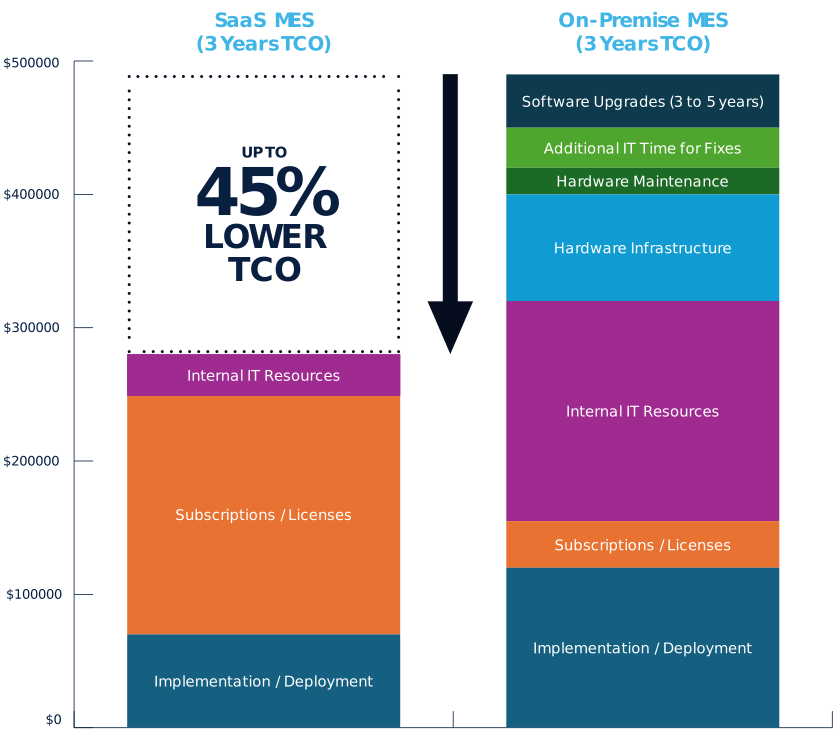
3-Year TCO $280,000
SaaS Savings ≈ $210,000 (~45%)
$490,000

Over a three-year period, a detailed cost analysis shows that an MES deployed in SaaS mode can offer up to a 45% reduction in total cost of ownership (TCO) compared to an on-premises deployment, while enabling faster implementation, simplified updates, and continuous access to the latest features and security standards provided by the cloud service provider on which the MES solution is built.

SaaS MES vs On-Premise MES – 3-Year Savings

TCO-3Years_EN.svg

Why a Cloud-Based Manufacturing Execution System (MES SaaS) Wins Far Beyond Just Cost


MES SaaS vs. PaaS and On-Premises: Understanding the Key Differences

Although the cost analysis in this article does not include the MES PaaS deployment model, it is important to understand its nuances to highlight the fact that MES SaaS is more cost-effective than both On-Premises and PaaS solutions. 

In fact, many cloud-based MES solutions are actually “platform as a service” (PaaS) platforms. An MES PaaS is a manufacturing execution system hosted in the cloud under the Platform as a Service (PaaS) model. In this model, the provider manages the underlying infrastructure (servers, storage, network, virtualization, databases), while the client company can create, customize, and operate its MES applications and modules according to its specific needs. 

Thus, the PaaS deployment model offers a high level of customization, allowing the creation of fully tailored screens and modules, such as Overall Equipment Effectiveness (OEE) tracking, root cause analysis of downtime, or quality control and traceability. However, the maintenance and operational costs can closely approach those of traditional on-premises MES. Each update to customized modules can cause screen malfunctions, requiring time for development and validation before the system returns to full operational capacity, not to mention potential production interruptions caused by these incidents. 

When analyzing the costs of different MES deployment types, it is important to consider that MES SaaS is designed to ensure that updates do not disrupt—or at least minimize disruptions to—the custom business rules of the manufacturing enterprise. 

Massive Reduction in IT Team Burden for MES Infrastructure Management

An on-premises MES typically requires an average of 0.5 full-time equivalent (FTE) employee to manage servers, maintenance, backups, and support, totaling about $150,000 over 3 years. With an MES SaaS, this drops to just 0.1 FTE (≈ $30,000), freeing your IT teams for higher-value projects and significantly reducing operational stress.

Seamless and Continuous Updates

An MES SaaS ensures immediate access to the latest features, patches, and security standards—several times a month if needed—without operational downtime. Traditionally, on-premises systems are upgraded every 3 to 5 years, which is now too slow given today’s critical security landscape. On-premises updates are costly, tie up internal teams, and put you at risk of unplanned outages; often, security is sacrificed to reduce operational load. MES SaaS, on the other hand, enables a cadence of continuous, secure updates that is difficult to match in an on-premises deployment model.

No IT Infrastructure to Manage

Forget the initial $80,000 investment for servers, storage, and networking, as well as the ongoing monitoring of physical infrastructure. With MES SaaS, everything is included in the subscription: hardware, hosting, maintenance, and scalability. You pay only for the value used, while reducing hidden costs and logistical constraints related to maintenance, electricity, physical space, daily operations, and infrastructure monitoring.

Enhanced Security and Resilience

MES SaaS solutions are built on highly secure (e.g., Microsoft Azure) and redundant cloud environments, significantly reducing risks related to business continuity and the protection of critical data. In contrast, on-premises deployments remain more vulnerable to outages, security incidents, and production interruptions because they generally rely on limited internal infrastructure, often without full redundancy or a specialized cybersecurity team available 24/7 to quickly detect and neutralize threats.

MES Agility and Scalability

In addition to being more cost-effective, MES SaaS solutions quickly adapt to business growth. Adding new users, production lines, or sensors is done without prolonged downtime or extra installation costs, ensuring operational continuity and performance.

Conclusion


MES SaaS, the Most Cost-Effective MES Deployment Model Over Three Years 

Choosing an MES is not just a technological decision; it is a strategic choice that directly impacts competitiveness and growth. Comparing the total cost of ownership (TCO) over three years, the SaaS model stands out as the most economical, while also offering rapid implementation and accelerated return on investment. 

For a manufacturing company, MES SaaS is not just an option: it is a true performance lever. Flexible, scalable, and far less demanding for IT teams, it reduces costs related to maintenance and technological obsolescence, while delivering tangible value from the very first months. 

By choosing a SaaS model, like OpRize MES, powered by Premier Tech Digital – Smart Manufacturing, manufacturers not only control their costs, but also build an agile digital infrastructure ready to support future growth. 

Appendix – Assumptions for the Total Cost of Ownership (TCO) Model of a Manufacturing Execution System (MES)


This appendix documents the assumptions underlying the main table. Unless otherwise noted, all amounts are in CAD.

Note 1. Initial Implementation Assumptions (Year 1)

Item MES SaaS On-premises MES Explanations
1. Configuration and customization time $25,000 $50,000 SaaS: minimal configuration with standard templates.
On-premises: extensive customization to fit internal processes.
2. Integration with existing systems (ERP, SCADA, etc.) $20,000 $35,000 SaaS: standard connectors and APIs simplify integration.
On-premises: more complex and longer integration.
3. Training and support $10,000 $20,000 SaaS: focused training for key users.
On-premises: multiple sessions (users + IT team).
4. Testing and validation $15,000 $15,000 SaaS: standardized tests provided by the vendor.
On-premises: additional validation on the client’s environment.
Total initial implementation $70,000 $120,000 Amounts reflected in the “Implementation / Deployment” row (Year 1).

Note 2. Subscription / License Assumptions (Years 1 to 3)

MES SaaS: $60,000/year 
Assumption based on ~150 users × ~$400/user/year. Includes software, hosting, maintenance, support, and integration of about 100 connected devices (no client-side hardware costs). 

On-premises MES: $25,000 (Year 1), then $5,000/year (Years 2 and 3) 
Covers software support (patches, minor updates, assistance). 
Year 1’s higher cost is due to initial onboarding/contract alignment (enhanced support, access rights, vendor onboarding), then $5,000/year for basic recurring support. These amounts correspond to the “Subscriptions / Licenses” row in the main table. 


Note 3. Hardware and Infrastructure Assumptions (On-premises)

Item Quantity Estimated Unit Cost Total On-premises SaaS (Comparison)
Physical / virtual servers 3 to 5 $10,000–$12,000 $30,000–$60,000 Included
Backup system (NAS or SAN) 1 $10,000 $10,000 Included
Server software & OS licenses 3 to 5 $1,000–$2,000 $3,000–$10,000 Included
Network infrastructure (switch, rack, cabling, power) 1 $5,000 $5,000 Included
Initial installation & configuration $5,000 $5,000 Included
Total infrastructure (Year 1) $80,000 Included, no client-side hardware costs
Note: Hardware maintenance is budgeted separately at $10,000/year in Years 2 and 3 (see main table).

Note 4. Internal IT Resource Allocation Assumptions

On-premises: ~0.55 FTE (≈ 85–95 hours/month), or $55,000/year 

  • Server/infrastructure maintenance: 10–12 hours/month 
  • Patches and security: 8–12 hours/month 
  • Backups/restores: 6–8 hours/month 
  • Incident management & recovery: 10–14 hours/month 
  • Integrations (ERP, SCADA, etc.): 12–16 hours/month 
  • Access management / changes / coordination: 12–14 hours/month 

SaaS: ~0.10 FTE (≈ 14–18 hours/month), or $10,000/year 

  • Coordination, functional administration, integration monitoring, and access management.

These amounts are reflected in the “Internal IT Resources” row ($10,000 SaaS; $55,000 On-premises per year). 


Note 5. Ongoing Support and Maintenance Assumptions (On-premises) 

  • Recurring basic support: $5,000/year (Years 2 and 3). About 20% of Year 1. 
  • Year 1 only: $20,000 startup cost (onboarding, rights, contract alignment, enhanced support), totaling $25,000 in Year 1.

These amounts correspond exactly to the “Subscriptions / Licenses” row in the main table ($25,000 then $5,000/year). 


Note 6. Additional IT Time for Patches, Testing, and Recovery Plan

  • On-premises:  Conservative provision of $10,000/year for unplanned outages (patch failures, hardware failures, obsolescence, resolution time, overtime). 
  • MES SaaS:  Not budgeted here (–); does not account for client-side internet outages or other external connectivity risks. 


Note 7. Major Software Upgrade Assumptions (Year 3)

Cost Item MES SaaS On-premises MES Detailed Explanations
Software upgrade license Included $15,000 SaaS: included / deployed by provider.
On-premises: access to new version paid separately.
Internal IT team labor Included $10,000 Planning, backups, environment preparation.
On-premises installation/config Included $8,000 Deployment on servers and related components.
Testing and validation Included $5,000 Functional checks, non-regression, ERP/SCADA integration.
Support during upgrade Included $2,000 Vendor/consultant assistance.
Total major upgrade (Year 3) Included $40,000 Amount as shown in the main table.

Join the Future of Manufacturing


Don’t get left behind in the rapidly evolving manufacturing industry 4.0. Partner with Premier Tech Digital and unlock the potential of Industry 4.0 with our solutions and expertise. Experience the future of manufacturing today!


Contact Us

Related Products