How MES Transforms Data into Operational Intelligence

The Data Process in a Manufacturing Execution System (MES)
In a manufacturing context, raw data has little value if it is not structured, analyzed, and leveraged effectively. This is precisely the role of a Manufacturing Execution System (MES), which transforms information from machine data into operational and strategic decision-making insights.
Data is crucial in an MES because it forms the very foundation of digital operations on the shop floor. Without data, an MES has no value. It is the quality, reliability, and richness of the collected data that transform an MES into a strategic and indispensable tool for manufacturing performance.
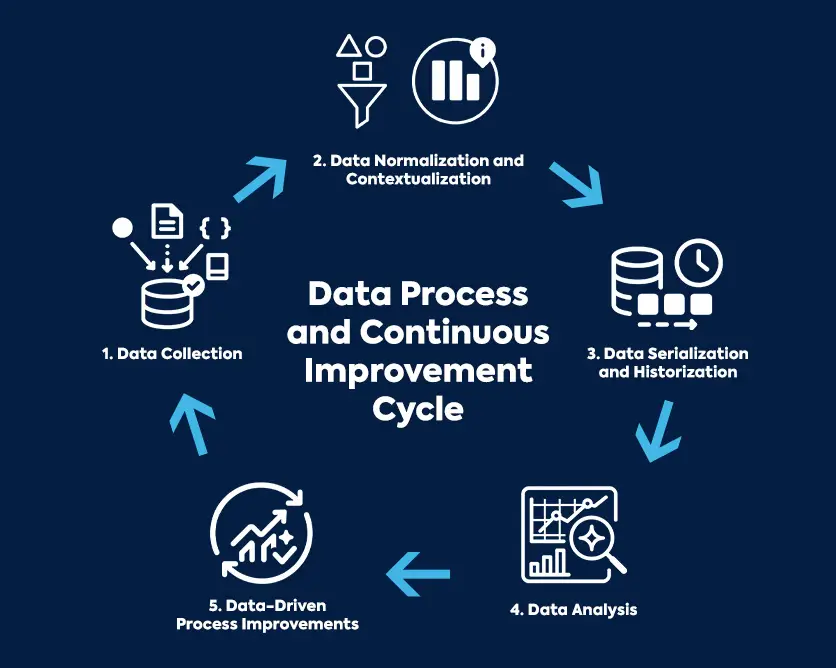
Data Collection in an MES: Capturing at the Source
Connecting the Manufacturing Execution System to Equipment and Systems
The first step of a Manufacturing Execution System (MES) is to collect data directly at the source, meaning on the shop floor. To do so, the MES connects to various layers of automation and data acquisition within the factory, such as:
- Programmable Logic Controllers (PLCs), which control equipment and provide precise information on machine status, production cycles, or process parameters.
- IoT sensors (temperature, pressure, vibration, humidity, etc.), which enhance real-time visibility into asset conditions and product quality.
- SCADA (Supervisory Control and Data Acquisition) systems, which already centralize a large portion of supervision data and enable the MES to interface easily with production lines or cells.
- Other acquisition and control systems, such as HMIs or industrial gateways, which complement data collection depending on the plant's technological architecture.
This automated data collection offers several strategic advantages:
- It reduces manual operator interventions for data entry, thus minimizing human error risks.
- It ensures data reliability and integrity, since information is captured directly from physical sources.
- It provides a continuous and real-time flow of critical information, essential for monitoring, optimization, and rapid decision-making.
Thanks to this direct connection to equipment and systems, the MES becomes the central nervous system of production, turning each captured data point into a concrete lever for performance and continuous improvement.
The non-automated data collection:
Automated collection is the foundation for reducing manual data entry. An MES is much more useful and efficient when operators and supervisors do not have to enter data that can easily be automatically collected. The MES will therefore only request the additional information necessary from humans, in order to reduce potential errors, wasted time, and, most importantly, to improve data reliability.
Data Normalization and Contextualization by the MES
Harmonizing and Providing Operational Context in the Manufacturing Execution System
Once collected, data must first be normalized. As each source uses its own format, the MES standardizes the data to enable consistent and reliable processing. Normalization is an essential step that converts data from different machines or systems into a unified format. Without it, each machine would speak its own language, making any global analysis practically impossible.
For example, if one machine sends temperature data in Celsius and another in Fahrenheit, the MES will convert all readings into a single unit for accurate tracking. Similarly, if a machine stoppage is labeled “Stop” on one line, “Stopped” on another, and “Shutdown” on a third, the MES harmonizes these states under a single label, such as “Stopped,” to analyze plant performance consistently. Through normalization, the MES becomes a true decision-making and optimization tool, making data clear, comparable, and actionable in real time.
For example, measuring a temperature of 150°C is meaningless if we don't know which machine it was taken from, for which product, and at which process step. Contextualization gives meaning to data, enabling precise analysis and rapid corrective actions.
It is this ability to contextualize information that makes the MES such an effective decision-support tool on the shop floor, capable of guiding production towards greater quality, efficiency, and performance.

Serialization and Historization: Ensuring Traceability with the MES
Organizing and Preserving Information Over Time
Once collected, normalized, and contextualized, data is serialized and historized by the Manufacturing Execution System (MES). Serialization involves organizing data in a structured and ordered way, assigning unique identifiers to each entry.
This makes it possible to track every product, batch, or operation throughout its lifecycle, from raw material input to finished goods. Historization ensures long-term data retention. All information is securely recorded and archived, creating a complete and searchable operational history. This step is essential for:
- Performance analysis: comparing historical data to identify trends, performance gaps, or continuous improvement opportunities.
- Demonstrating compliance: during quality or regulatory audits, historical data proves that each process step was performed according to standards.
- Managing non-conformities and product recalls: in case of quality issues, it becomes possible to quickly trace the origin of a batch, identify affected products, and act efficiently to mitigate risks.
By organizing and preserving data in a structured way, the MES ensures complete, secure, and reliable traceability, which is indispensable for manufacturing performance, quality, and compliance.
Data Analysis: Turning Data into Operational Intelligence
KPI Calculation and Variance Detection in the MES
After data has been collected, normalized, contextualized, and historized, the MES processes it to extract concrete and measurable value. This is where raw data is transformed into true operational intelligence. The MES calculates real-time Key Performance Indicators (KPIs) essential for production management, such as:
- OEE (Overall Equipment Effectiveness): measuring actual equipment or line effectiveness based on availability, performance, and quality.
- Cycle times: analyzing the production time per product or batch to identify bottlenecks.
- Machine downtimes: quantifying their frequency and duration to quickly target major causes of productivity loss.
Through these analyses, the MES can also detect variances from production standards or expected performance thresholds. When a significant deviation is identified – such as an unusual slowdown, quality drift, or prolonged stoppage – the system triggers targeted alerts. These real-time notifications allow operators, supervisors, and engineers to react immediately before the issue affects quality, safety, or overall productivity.
Thus, MES data analysis goes far beyond simple dashboards. It actively supports continuous improvement by highlighting optimization opportunities and enabling fast, informed decision-making, which is essential for today’s manufacturing performance.
Integrating the MES into the Factory’s Digital Ecosystem
Connecting the Manufacturing Execution System to Other Enterprise Systems
Finally, a Manufacturing Execution System (MES) unleashes its full potential when integrated into the factory's entire digital ecosystem. This integration occurs both vertically (with enterprise management systems) and horizontally (with other operational systems).
In practical terms, the MES connects its real-time data to solutions such as:
- ERP (Enterprise Resource Planning): to receive production orders, synchronize inventories, and send precise production status updates, ensuring a unified financial and operational view.
- APS (Advanced Planning and Scheduling): to provide real capacity and availability data, enabling optimized planning and quick reactions to unexpected changes.
- WMS (Warehouse Management System): to manage and track raw materials, components, and finished goods movements, ensuring smooth and uninterrupted logistics.
This integration eliminates information silos that hinder productivity and decision-making. It ensures complete digital continuity, from strategic planning down to execution on the shop floor. By connecting the MES to other enterprise systems, manufacturers enhance synchronization between planning, procurement, and execution, resulting in:
- Better resource utilization
- Shorter cycle times
- Increased responsiveness to demand changes or disruptions
- Overall optimized performance
This integration capability is what makes the MES a true pivot of the smart factory, ensuring that every decision, at all organizational levels, is based on reliable, real-time, and fully contextualized data.

Join the Future of Manufacturing
Don’t get left behind in the rapidly evolving manufacturing industry 4.0. Partner with Premier Tech Digital and unlock the potential of Industry 4.0 with our solutions and expertise. Experience the future of manufacturing today!